
CleverSpeed Resources
Managed ExpressRoute vs self-service for Compliance and Sovereignty
← All resources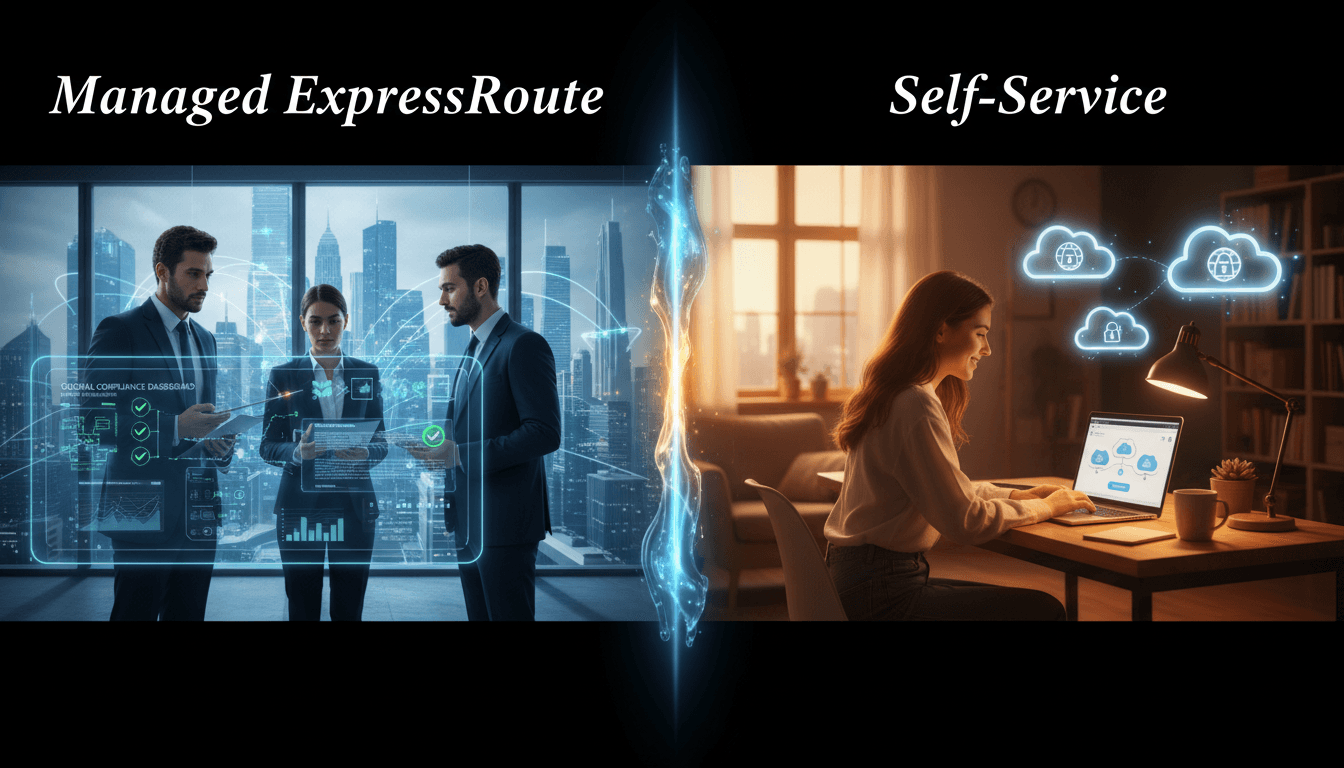
The hidden cost of cloud egress, fragile public internet routing, and regulatory exposure are not technical curiosities — they are mission risks. Singapore CTOs must weigh long-term architectural stability, not just upfront cost. We guide that decision with operational clarity and engineering rigor.
Our view: sovereignty requires an architecture, not an afterthought. The Sovereign Stack is our strategic blueprint; it pairs high-performance transit with Proxmox and CEPH virtualization to keep critical data in‑scope for MAS and IMDA compliance.
As a Tier 2 MSP, we provide deep engineering oversight for Microsoft Azure deployments; we handle gateway design, Layer 2 transit, and BGP policies so your applications keep predictable bandwidth, latency, and security. CleverSpeed removes the operational burden of DIY networking and ensures connections meet enterprise requirements across regions and site exchanges.
Key Takeaways
- Hidden egress and routing risk can undermine compliance and predictability.
- The Sovereign Stack is an architectural approach, not a single product.
- We deliver Tier 2 MSP engineering for Azure to secure data residency and performance.
- Proxmox + CEPH and premium transit reduce latency and operational overhead.
- Request a Managed Cloud Network Review to align connectivity with regulatory needs.
The Strategic Shift in Enterprise Connectivity
Enterprises are moving their mission-critical workloads off the commodity internet and onto private, high-capacity transit to secure predictable performance.
Azure ExpressRoute allows organisations to bypass the public internet and establish a dedicated path for their data. This reduces latency, limits jitter, and gives predictable gbps-level bandwidth for analytics and hybrid cloud integration.
We design connectivity so gateway configuration, BGP policies, and bandwidth planning align with business risk and regulatory needs. That engineering reduces traffic variability and improves access to Microsoft Azure virtual network endpoints across regions and exchanges.
At the infrastructure level, this shift changes cost models and operational responsibilities. Premium transit increases upfront cost, but it stabilizes application performance and lowers long-term risk for companies handling sensitive data.
- Predictable throughput: dedicated connections for analytics and high-bandwidth applications.
- Operational clarity: expert gateway and network integration to avoid downtime.
- Regulatory alignment: clearer data paths for compliance across sites and regions.
Managed ExpressRoute vs self-service: Defining the Architectural Divide
We evaluate the split between turnkey circuits and DIY networking through two lenses: measurable performance and day-to-day operations.
Technical Performance Metrics
Uptime: dedicated circuits offer a 99.9% uptime guarantee, delivering predictable access for mission workloads.
Throughput: standard speeds range from 50 Mbps to 10 Gbps; this supports analytics, gbps-level replication, and high-throughput applications.
Operational Overhead
Our engineering team monitors BGP sessions and gateway health to stop unexpected downtime. We provision virtual networks and handle peering so your staff can focus on applications.
Cost control: expert provisioning reduces misconfiguration and hidden egress spikes that inflate cloud services bills.
“Private peering ensures sensitive data never traverses the public internet; that architectural choice is key to compliance and performance.”
| Metric | Turnkey Circuit | DIY VPN |
|---|---|---|
| Uptime | 99.9% SLA | Variable; dependent on provider |
| Throughput | 50 Mbps – 10 Gbps | Typically |
| Operational effort | Low; vendor + MSP monitoring | High; internal routing and gateway ops |
| Security path | Private peering to access Azure | Traffic may traverse public internet |
For Singapore enterprises, our consultative approach ties bandwidth and SKU selection to growth plans. Learn more about our transit foundation at ip transit backbone.
Navigating MAS and IMDA Compliance Standards
Meeting MAS and IMDA standards starts with network design that enforces where data lives and how traffic is inspected.
Regulatory Alignment
MAS and IMDA mandate strict data residency and security controls for financial and government institutions in Singapore. These rules shape how you design connectivity, gateways, and hybrid network topologies.
We ensure your cloud infrastructure is architected to meet those requirements; we deliver documentation and audit trails your compliance officers expect.
- Data residency: enforce storage locality and authorized access within approved regions.
- Isolated connectivity: private expressroute paths reduce reliance on the public internet and lower exposure.
- Secure gateways: deploy traffic inspection and policy enforcement at ingress and egress points.
- Architectural evidence: diagrams, configs, and runbooks to support audits and attestations.
By integrating networks with our Sovereign Stack, you retain control over sensitive data while leveraging Microsoft Azure scale. Speak with a Sovereign Infrastructure Specialist to review your compliance posture and next steps; for technical reference see our Microsoft Azure compliance offerings.
The Hidden Costs of Self-Managed Cloud Networking
DIY connectivity can look cheaper at first; the long tail tells a different story. Outbound cloud traffic from Azure to on‑prem often incurs fees between $0.025 and $0.14 per GB. Those charges compound quickly for analytics, backups, and replication.
Financial risk shows as unpredictable egress bills and monthly surprises when traffic spikes. Operational risk appears as ongoing staffing and the expertise needed to tune gateways, BGP policies, and virtual network routing.
Without careful planning, teams over‑provision bandwidth and pay for idle gbps capacity. We reduce that waste by auditing access patterns and optimising routing to lower total cost of ownership.
- Visibility into traffic to stop avoidable egress charges.
- Right‑sizing connections to avoid excess monthly spend.
- Policy‑driven routing that balances latency, security, and cost.
“Surprise egress costs are a governance problem; they require architecture and ongoing telemetry.”
| Risk | Impact | Mitigation |
|---|---|---|
| Unpredictable egress fees | High monthly cost | Traffic visibility; routing optimisation |
| Over‑provisioned bandwidth | Wasted spend on idle gbps | Capacity right‑sizing; usage-based planning |
| Skill shortage | Operational outages and latency | Tiered support and runbooks |
We encourage a cloud network review; discover concrete savings and practical solutions by visiting our analysis of ip transit vs transport.
Sovereign Cloud Infrastructure and Data Residency
Sovereign stacks anchor where critical information lives; they translate compliance needs into enforceable infrastructure. We build designs that keep control, visibility, and auditability close to your approved sites.
Data Sovereignty Requirements
Singapore regulations require clear custody and locality for certain classes of data. We map those mandates to physical and logical controls so governance teams have evidence for audits.
We ensure network and gateway configurations restrict access to authorised resources. That reduces exposure to the public internet and tightens security for sensitive workloads.
Localized Storage Solutions
Our Sovereign Stack uses CEPH for distributed, local storage. CEPH keeps copies of your data within jurisdictional boundaries and enables scalable resilience.
Proxmox provides the virtualization layer; it unifies management and avoids vendor lock-in. Together, these technologies let you run hybrid deployments with secure connections to Microsoft Azure while retaining local control.
- Local control: data remains on-site or inside approved regions.
- Operational flexibility: Proxmox + CEPH reduces vendor dependence.
- Connected hybrid: secure connectivity and bandwidth planning to cloud services.
“Keeping data local is a strategic choice; it converts regulatory obligation into repeatable infrastructure practice.”
| Capability | What We Deliver | Benefit |
|---|---|---|
| Localized storage | CEPH clusters on sovereign racks | Compliance, durability, low latency |
| Virtualization | Proxmox management plane | Unified operations; avoids lock-in |
| Hybrid connectivity | Secure connection to Microsoft Azure and expressroute direct where required | Predictable access; reduced public internet exposure |
We balance local control with cloud scalability; our architects design data residency strategies that match risk, cost, and performance targets. Talk with a Sovereign Infrastructure Specialist to review your environment.
Eliminating BGP Downtime through Expert Management
Preventing routing loops and flapping requires expert BGP policy design paired with vigilant telemetry and rapid remediation.
BGP is the backbone of expressroute connectivity; precise route filtering, path preferences, and community tagging stop loops before they start. We codify routing policies and verify advertisements to keep your virtual network reachability deterministic.
We provide 24/7 oversight of circuit health and gateway state. Our team detects route flaps, asymmetry, and incorrect prefixes and fixes them before traffic is impacted.
- Proactive routing audits: regular reviews of routing tables and prefix limits to reduce risk.
- Redundant gateways: failover paths ensure continuous access to microsoft azure and local resources.
- Operational telemetry: real-time alerts and runbooks for rapid remediation of BGP events.
Outcome: resilient network architecture that preserves bandwidth, maintains security, and reduces unexpected cost from outages.
“Eliminating BGP downtime is a core competency; proactive management prevents the misconfigurations that cause hybrid-cloud failures.”
Request a Managed Cloud Network Review to see how our expert service removes BGP-related risk from your environment and secures connection to azure expressroute and expressroute direct.
Why Tier Two MSPs Outperform Commodity Providers
Tier Two providers win where commodity vendors fail: they engineer outcomes, not transactions.
We act as an extension of your team. Our engagement starts with architecture and ends with operational ownership. That means we design network topology, secure gateways, and plan bandwidth to meet your compliance and performance targets.
We offer white-glove provisioning so your infrastructure is right the first time. This reduces costly rework, limits traffic surprises, and preserves predictable access to microsoft azure and virtual network endpoints.
Differentiating from red ocean competitors
We focus on long-term outcomes. Our engineers specialise in Proxmox, CEPH, and hybrid cloud integrations. That skills stack solves complex data locality and security challenges commodity services cannot.
- Consultative partnership: tailored designs, not one-size contracts.
- White-glove provisioning: minimise configuration errors and downtime.
- Senior engineering: deep expertise in hybrid connectivity and bandwidth planning.
“Choosing a Tier Two partner transforms connectivity from a line item into a strategic asset.”
Speak with a Sovereign Infrastructure Specialist to learn how our high-touch service secures your connections and aligns cloud strategy with regulatory needs.
Architectural Expertise in Hybrid Cloud Environments
A resilient hybrid cloud starts with architecture that treats on‑site and Azure resources as a single operational domain.
Hybrid environments require seamless integration between datacenters and virtual network endpoints to keep performance and security predictable.
We design network patterns that ensure data flows reliably between on‑prem systems and Microsoft Azure. Our approach covers gateway policy, traffic shaping, and bandwidth planning so access is consistent for mission workloads.
- Architectural foundation: the right design reduces latency and enforces security boundaries.
- Seamless connectivity: rigorous topology design keeps data inside approved paths.
- Operational guidance: we codify runbooks and service levels to protect availability.
Our team maps complex connections, audits traffic, and aligns services to your compliance needs. We take a consultative stance so your hybrid strategy grows with measurable outcomes.
“Architecture is the control plane for sovereignty—well‑designed networks convert policy into enforceable practice.”
Request a Managed Cloud Network Review to evaluate your hybrid design and identify optimization opportunities; see our private fibre comparison for related guidance.
Reducing Cloud Egress Fees with Intelligent Routing
By aligning routing policy to traffic intent, we stop avoidable data movement and reduce recurring cloud fees.
Intelligent routing shapes the path your data takes between Azure and on‑premises systems so you pay for necessary transfers only. We map traffic types, peak windows, and destination locality; then we apply route preferences that push bulk replication over cost‑efficient links while keeping interactive flows on low‑latency connections.
Our engineers audit application patterns and gateway configurations to find savings opportunities. We implement policy‑based routing and selective advertising so cloud services egress is minimised without harming performance or security.
- Cost reduction: optimise routes to limit outbound cloud charges.
- Visibility: telemetry that shows egress by workload and connection.
- Custom policy: routing tuned to each network and service requirement.
For a practical cost analysis, review our direct transit pricing and routing guidance at direct China IP transit price. Speak with a Sovereign Infrastructure Specialist to tailor routing to your workloads and lower monthly cloud expenses.
White Glove Provisioning for Mission Critical Workloads
Our provisioning process combines engineering checklists, staged validation, and controlled cutovers to protect service continuity.
White‑glove provisioning is our standard for mission‑critical workloads. We manage a rigorous, multi‑step workflow that moves from initial planning to final validation. Each step has measurable gates and a documented rollback plan.
We perform gateway configuration, route validation, and network hardening so applications retain predictable connectivity to Microsoft Azure and on‑prem systems. Tests include failover verification, traffic shaping checks, and latency profiling.
Our team delivers operational artifacts: runbooks, BGP policy records, and audit logs. These support compliance reviews and give your architects the evidence they need.
Outcomes: reduced deployment risk, faster time to production, and lower operational burden for your staff. We consult on capacity planning and align service choices to workload patterns and data residency needs.
- End‑to‑end deployment with stage gates and validation.
- Gateway and network settings tuned for predictable traffic flows.
- Security and performance checks before cutover to production.
- Tailored runbooks and audit evidence for compliance.
“White‑glove provisioning converts architectural policy into reliable, repeatable production outcomes.”
| Phase | Key Activities | Deliverable |
|---|---|---|
| Plan | Requirements mapping; topology and capacity design | Design document; acceptance criteria |
| Build | Gateway config; route policies; security hardening | Configured gateway; test reports |
| Validate | Failover tests; traffic validation; compliance checks | Validation logs; runbooks |
| Cutover | Controlled migration; monitoring ramp; rollback ready | Production sign‑off; telemetry baseline |
To see how white‑glove provisioning supports your most critical enterprise applications and helps you access Azure with predictable connectivity, request a Managed Cloud Network Review or learn about our approach to SD‑WAN and MPLS integration at sd‑wan and mpls guidance.
The Role of Proxmox and CEPH in Sovereign Stacks
Proxmox and CEPH form the technical bedrock for sovereign stacks, delivering local control over compute and resilient software‑defined storage. Together they give organisations predictable connectivity and a clear path to meet data residency requirements.
Proxmox Virtualization Benefits
Proxmox provides a unified management plane that simplifies VM and container lifecycle operations.
It reduces operational overhead for gateway and hypervisor maintenance while keeping your network topology transparent to architects.
CEPH Scalability
CEPH scales capacity and performance without forklift upgrades; this preserves locality for critical data and supports heavy I/O workloads.
Result: resilient storage that grows with demand and keeps copies inside approved jurisdictions.
Unified Management
We combine both platforms into a single operational model so teams monitor compute, storage, and connectivity from one pane.
- Flexible foundation: avoids vendor lock‑in and preserves architectural choice.
- Operational clarity: runbooks, telemetry, and capacity planning for sovereign services.
- Integration: seamless links to expressroute and microsoft azure endpoints where hybrid access is required.
Speak with a Sovereign Infrastructure Specialist to review how Proxmox and CEPH can secure your network, gateway design, and data strategy; for platform comparisons see vSphere alternatives.
Consultative Approaches to Infrastructure Modernization
Modernising infrastructure requires a multi-year partnership that ties technical choices to measurable business outcomes.
We begin with a pragmatic assessment of your network and gateway estate. That review maps where data sits, what paths it takes, and how you access azure today.
Our consultative process aligns technical investments with growth and compliance priorities. We build a phased roadmap that reduces risk and preserves operational continuity.
- Assess current environment and identify modernization opportunities for network and gateway improvements.
- Recommend phased upgrades to improve connectivity and to reduce operational risk across cloud services.
- Guide migrations so teams can reliably access microsoft azure and maintain data locality during transition.
- Transfer knowledge with runbooks and training so your staff manage the modernised infrastructure with confidence.
Outcome: an auditable, scalable platform that limits surprise costs, preserves sovereignty of data, and supports high‑performance cloud service integration.
“A consultative roadmap turns technical debt into a predictable, secure path to modern cloud operations.”
Request a Managed Cloud Network Review to start the journey toward better connectivity and gateway hygiene that helps you access azure with predictable performance.
Conclusion
A deliberate connectivity strategy converts regulatory mandates into enforceable infrastructure practice.
We summarise the benefits: a sovereign stack built on Proxmox and CEPH gives local control, resilience, and clear audit evidence for sensitive workloads. This design reduces surprise costs and keeps cloud traffic predictable.
Our engineers align azure expressroute links, gateway settings, and routing so expressroute paths deliver low‑latency connectivity to Microsoft endpoints. That approach secures your cloud services and preserves data locality.
Partnering with CleverSpeed gives you architectural oversight and high‑touch operational support to modernize network design and protect critical assets.
Ready to act? Request a Managed Cloud Network Review or speak with a Sovereign Infrastructure Specialist to start a tailored service engagement.
FAQ
What are the primary compliance and sovereignty considerations when choosing between a managed private connectivity service and a self-provisioned cloud circuit?
You need clear data residency controls, auditable chain-of-custody for traffic, and alignment with MAS and IMDA controls; an expert-managed service layers policy enforcement, encrypted circuits, and proof of physical pathing to reduce regulatory risk while a DIY approach demands internal governance, rigorous change control, and additional tooling to meet the same standards.
How does an expert-managed circuit materially change operational overhead compared with self-provisioning networks?
Expert teams centralize lifecycle tasks—provisioning, firmware management, BGP path tuning, and incident remediation—so in-house teams avoid repetitive operational work; this reduces mean time to repair, frees engineering capacity, and lowers the probability of misconfiguration that can lead to outages or noncompliance.
Which technical performance metrics should enterprise architects demand for low-latency, high-throughput connectivity?
Insist on SLA-backed latency and jitter targets, packet loss thresholds, guaranteed bandwidth profiles (Gbps), deterministic routing policies via BGP, and measurable end-to-end path visibility; these metrics support predictable application performance for ERP, Exchange, analytics, and other critical systems.
What hidden costs arise from running cloud networking entirely in-house?
Beyond capital outlay and bandwidth fees, hidden costs include staff upskilling, shift coverage for 24/7 support, audit readiness, vendor coordination, and the financial impact of misconfigurations; unmanaged routing can also increase cloud egress spend through suboptimal paths and retransmissions.
How do we ensure compliance with MAS and IMDA when traffic transits multiple carriers or public internet hops?
Use provider attestations, physical path guarantees, and end-to-end encryption; require carriers to demonstrate segregation controls and localized peering. For Singapore-specific mandates, maintain documented evidence of where data is stored, how transit is controlled, and who has administrative access.
What architecture patterns preserve data sovereignty while enabling hybrid cloud agility?
Combine localized storage and compute zones with federated control planes; enforce data residency through policy-driven routing, dedicated circuits into regional cloud zones, and selective on-premise processing for sensitive workloads; this hybrid stance prevents vendor lock-in and supports compliance.
Can expert circuit management eliminate BGP-related downtime, and how?
Yes—through proactive route validation, automated path health checks, graceful failover design, and rigorous change control. Engineers apply prefix filtering, AS-path policies, and session resilience techniques to prevent common BGP failure modes that cause prolonged outages.
What differentiates a Tier Two specialist MSP from commodity connectivity providers?
A Tier Two MSP offers deep architectural services, sovereignty-aware design, white-glove provisioning, and engineering-led SLAs; they prioritize deterministic outcomes—security, compliance, and resiliency—rather than competing solely on price, which is typical of red-ocean providers.
How should enterprises evaluate a provider’s hybrid cloud architecture expertise?
Verify real-world integration experience with virtual networks, gateway orchestration, Layer 2/Layer 3 bridging, and orchestration systems such as Proxmox. Ask for architecture reviews, runbooks, and case studies demonstrating successful migrations and interoperability with public cloud services.
What strategies reduce cloud egress expenses without compromising sovereignty?
Implement intelligent routing to local peering points, use dedicated circuits into cloud regions to avoid public internet transit, and apply traffic engineering to keep sensitive flows on private links. Caching, compression, and selective regional processing also lower egress volumes.
What does white-glove provisioning look like for mission-critical workloads?
It includes bespoke design workshops, staged validation in a sandbox, coordinated cutover windows, end-to-end acceptance testing, and runbook handover. Providers deliver end-state documentation, SLA definitions, and post-deployment optimization to meet strict uptime and security targets.
How do Proxmox and CEPH contribute to a sovereign infrastructure stack?
Proxmox provides flexible virtualization with strong control over hypervisor and networking layers; CEPH offers scalable, resilient object and block storage with multi-site replication. Together they enable localized control, audited storage residency, and scalable performance for enterprise applications.
What operational benefits stem from unified management of virtualization and storage?
Unified management reduces operational friction: single-pane monitoring, coordinated patching, and consolidated backup and DR workflows. This lowers human error, shortens remediation times, and enforces consistent compliance policies across the stack.
How do consultative modernization approaches mitigate vendor lock-in risk?
A consultative partner designs modular architectures, enforces open standards, and recommends neutral transport options; they prioritize portability—containerization, platform-agnostic storage, and multi-cloud connectivity—so enterprises retain sovereignty and exit flexibility.