
CleverSpeed Resources
Unlock the Power of SD-WAN: Traditional WAN vs. SD-WAN Explained
← All resources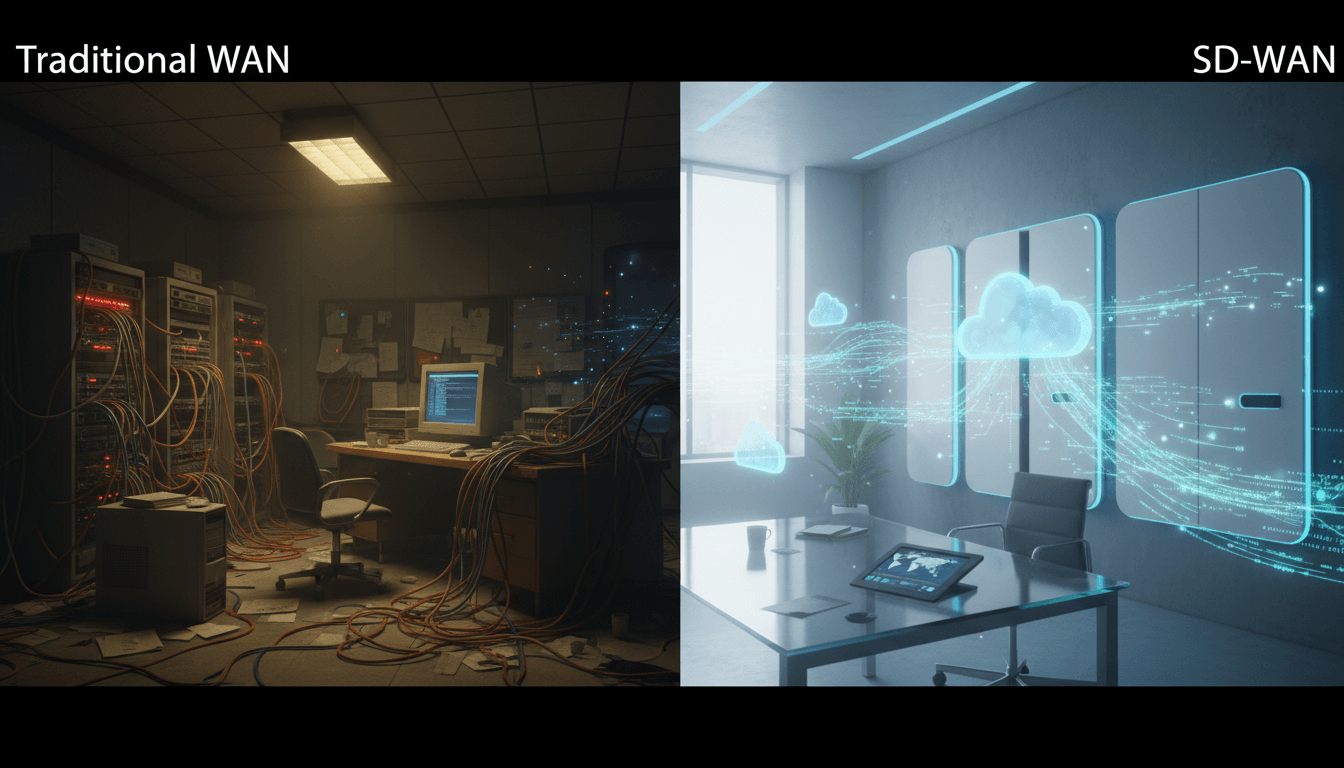
Can one networking change really make cloud apps faster, cut costs, and simplify security for Singapore firms?
We lay out a clear comparison so decision-makers can act with confidence. At its core, one model uses hardware routers and manual rules, while the other offers a software overlay with centralized control and dynamic traffic steering across multiple links.
Cloud-first delivery, SaaS growth, and hybrid work have pushed critical traffic beyond the data center. We explain how this shift affects performance, security, and day-to-day management for local businesses.
Throughout the article we will define what “better” means—measured application experience, predictable reliability, consistent security controls, and manageable cost over time. We also note that a hybrid model (software overlay plus MPLS) often suits complex needs.
Key Takeaways
- What to measure: performance, security, operations, and ROI.
- Why now: cloud and SaaS usage demand smarter routing.
- What to expect: improved scalability and centralized policy control.
- Real-world view: hybrid deployments remain practical for many businesses.
- Evaluation criteria: connectivity options, routing behavior, and scaling effort.
- Singapore focus: multi-site needs and compliance shape the right approach.
Why This Comparison Matters for Singapore Organizations Today
Rising cloud use and distributed teams force organisations in Singapore to rethink how their networks deliver services.
As more workloads move to the cloud, expectations for app performance rise. Remote staff and vendors now rely on low-latency access to SaaS and web-based applications. When delay or jitter affects meetings or CRM access, business impact is immediate.
Cloud-first adoption, SaaS performance, and remote work pressure
We see cloud-first strategies driving direct internet access from branches and homes. This shift reduces backhaul but raises the need for smarter routing and unified policies. Good performance now depends on how the network handles internet-bound services and encrypted flows.
Branch offices, multiple sites, and shifting traffic patterns
Organisations with many locations feel strain first. Voice and video, ERP, and security inspection create uneven traffic that legacy designs did not expect.
- Local reality: More cloud services and SaaS usage demand predictable experience.
- User-centric flows: User-to-cloud paths often beat branch-to-datacenter routes for relevance.
- Decision point: We must choose whether to keep optimising existing networks or adopt a model that aligns network behaviour with modern cloud demands.
Traditional WAN Basics: What It Is and How It Works
Many enterprises still rely on hardware-led designs that stitch sites together with fixed routing and provider circuits.
How the architecture looks: routers sit at each site and forward traffic using device-level rules. This appliance-centric network uses manual configuration and local policies to control paths and behaviour.
Why MPLS took hold: service providers offered predictable performance and QoS, so MPLS became a common choice for low-latency, managed links.
Common connectivity and typical uses
- Leased lines and private circuits for point-to-point links.
- MPLS for provider-managed QoS across multiple sites.
- Use cases: branch-to-headquarters, data centers interconnectivity, and controlled remote access.
| Component | Purpose | Operational reality |
|---|---|---|
| Site routers | Forward data and enforce local policies | Configured per device; changes need careful validation |
| MPLS circuits | Provide predictable QoS and managed paths | Higher recurring cost but steady performance |
| Leased lines / private circuits | Dedicated bandwidth for critical links | Reliable but inflexible and slow to scale |
Control is a clear advantage — dedicated links and provider oversight simplify predictability. Yet this often comes at the expense of flexibility and cost.
For more technical detail on differences with newer overlays, see our reference on traditional WAN and software overlays.
SD-WAN Basics: What It Is and How It Works
A software-defined overlay lets organisations steer critical apps across the best connections in real time. We define the design as a virtual layer that abstracts underlying transport and centralizes control.
Software-defined overlay and a centralized control plane
The overlay uses SDN principles and a central control plane to push intent and policies to every site. Instead of changing devices one-by-one, we set rules once and the system enforces them consistently.
Hybrid connectivity: multiple link types
SD‑WAN aggregates diverse connections — mpls, broadband, LTE, VPN, wireless and the public internet — to boost resiliency and available bandwidth. This mix improves overall connectivity and lowers single-link risk.
Dynamic traffic steering and application-aware routing
SD‑WAN continuously measures link health — latency, jitter, and packet loss — and routes traffic per application. That means better performance for SaaS and collaboration, fewer user complaints, and faster root-cause diagnosis.
“We moved from device-level changes to intent-driven policy and saw measurable improvements in cloud app performance.”
| Feature | What it does | Business impact |
|---|---|---|
| Central control plane | Deploys policies uniformly | Faster change, fewer errors |
| Link diversity | Uses mpls + broadband + LTE + VPN | Higher uptime and capacity |
| Application-aware routing | Chooses path per app | Improved user experience |
| Built-in encryption | End-to-end VPN overlays | Baseline security for data in transit |
Many organisations adopt sd-wan solutions as a practical step toward modern network and security management. We recommend evaluating how a centralized policy model maps to your application and compliance needs in Singapore.
Traditional WAN vs SD-WAN: Core Differences That Impact Performance and Operations
Choosing the right network model affects day-to-day operations, cloud access, and how quickly sites come online. We focus on practical contrasts that shape cost, risk, and user experience for Singapore organisations.
Network management
Device-by-device changes mean long change windows and inconsistent policies. In a centralized model, we push intent once and the network enforces it everywhere.
Traffic optimization and routing
Fixed routing follows pre-defined paths and can ignore real-time link health. Dynamic path selection monitors latency and packet loss, steering traffic to preserve application performance.
Cloud connectivity and scalability
Backhauling through data centers can add delay for cloud services. Direct cloud access shortens paths and improves SaaS experience.
Adding new sites with boxes and manual setup takes weeks. Using templates and centralized management cuts deployment time and reduces human error.
Bandwidth, latency, and application outcomes
When bandwidth shrinks or latency spikes, VoIP, video, and ERP face drops or freezes. An operations model that adapts traffic in real time keeps critical applications working and reduces mean time to repair.
Reliability and Application Performance for Critical Business Traffic
Critical apps demand a predictable path — and networks must be designed to meet that need. We look at how predictable circuits and modern overlays each protect application experience.
MPLS QoS and predictable circuits
MPLS remains valued for reliability. Provider-managed circuits give QoS controls that prioritise voice and ERP traffic. That predictable carriage reduces jitter and helps meet strict SLAs for latency-sensitive applications.
Resiliency with link aggregation and failover
Modern overlays use multiple connections to boost uptime. Link aggregation increases available bandwidth and supports automatic failover when a path degrades.
Continuous monitoring of jitter and packet loss lets systems reroute flows in real time—protecting performance for critical applications.
The public internet factor and mitigation
The public internet carries variability—route changes and congestion can harm performance despite smart routing. For strict requirements, a hybrid approach works well.
Combining MPLS circuits for the most sensitive workloads with broadband for scale balances cost and reliability. Some vendors also offer overlays on a private backbone to reduce internet unpredictability while keeping flexible policy control.
Decision lens: define reliability targets per application, then map those targets to the right mix of circuits and policies. For hybrid operations and best practices, see our guide on hybrid WAN management.
Security and Control: Dedicated Circuits vs Integrated SD-WAN Security
How we secure site-to-cloud traffic determines both risk and business continuity.
Separate appliances rely on edge firewalls and on-prem tools. This can reduce exposure when private circuits are used, but it often creates uneven policy enforcement across sites.
Manual updates cause policy drift. Changes that are applied locally lead to inconsistency and higher operational risk. That increases time to detect and fix gaps.
Integrated overlays and unified policy control
Modern overlays provide end-to-end encryption and central policy deployment. We push rules from a single console and enforce them at every site and connection.
Benefits:
- Consistent policies across sites — fewer configuration errors.
- Encrypted overlays protect data in transit across mixed connections.
- Faster incident response — security and network control converge.
SD‑WAN as a foundation for SASE
When combined with cloud security, the overlay becomes a SASE-ready foundation. Core services include Secure Web Gateway (SWG), CASB, and ZTNA.
“Treat the overlay as an enabler — not a full replacement for all controls.”
Practical takeaway for Singapore firms: define desired security and control levels first. Then choose connectivity and policies that enforce them everywhere. For network design tied to cloud replication and regional reach, review our guidance on cloud replication connectivity.
Costs and ROI: MPLS Circuits, Broadband Options, and Ongoing Management
We start with clear numbers so leaders can weigh monthly spend against business outcomes.
Where costs add up
MPLS and dedicated circuits drive high recurring bills — circuit fees, maintenance contracts, and provider SLAs. Hardware lifecycle and software licences add one‑time and refresh costs.
The worst hidden cost is time: device changes, troubleshooting, and project delays raise operational overhead and staffing needs.
How modern solutions improve ROI
Using broadband and internet links in a hybrid design can lower per‑Mbps cost and raise usable capacity. Centralized management reduces on‑site work and shortens change windows.
Benefits: lower recurring costs, faster deployments, and simpler infrastructure upgrades.
When savings are not guaranteed
Upfront investment and design complexity can offset early gains. In locations with limited broadband competition, circuit pricing stays high.
- Compare total cost of ownership — circuits, hardware, licences, and support.
- Model change frequency and expected management savings.
- Validate local broadband options for each site.
Use our procurement checklist and run a TCO model to verify the ROI for your organisation. For sizing and bandwidth guidance, see SME bandwidth requirement.
Advantages and Limitations of Traditional WAN
For firms that prioritise predictable application delivery, older circuit-based networks still answer key business requirements.
Strengths:
- Predictable reliability: Provider SLAs and private circuits give steady uptime and consistent performance.
- Low latency: Dedicated links minimise jitter for voice and real‑time apps.
- Strong control: Network teams keep clear policy boundaries and tight traffic segregation via private connectivity.
Operational complexity grows with each new router, circuit, and policy. That increases staffing effort and troubleshooting time.
Provisioning new sites can take weeks — procurement, circuit delivery, and hardware installs add significant time. Scaling bandwidth or adding locations raises recurring cost and ties up capital in network infrastructure.
When does this model make sense? Keep it when existing contracts are favourable, change frequency is low, and stringent reliability or latency requirements outweigh the need for agility.
Advantages and Limitations of SD-WAN Solutions
Modern overlay platforms deliver faster deployments and clearer control for multi-site firms. We see real gains where teams need rapid change and predictable cloud access.
Strengths
Agility: Centralized templates let us roll out changes across sites in minutes. That reduces manual errors and speeds time to value.
Configuration and turn-up: A single control plane manages configuration, so new sites come online faster with consistent policies.
Cloud performance: Direct cloud access and dynamic path selection improve SaaS and collaboration performance — users notice fewer drops and faster app responses.
Trade-offs
Implementation can be complex. Integrating with existing infrastructure and security stacks demands planning and skills.
Public internet route quality affects outcomes. Without the right connections or monitoring, reliability for critical apps can suffer.
Design choices that improve outcomes
- Adopt a hybrid approach — combine provider circuits with internet links for resilience.
- Use performance-aware routing and tuned policies per application to protect SLA-sensitive traffic.
- Consider a managed solution if internal skills or circuit options are limited.
“Design well: hybrid connections plus policy-driven routing deliver measurable performance wins for cloud-first firms.”
We recommend linking design decisions to measurable KPIs — SaaS latency, outage counts, and mean time to repair. For practical comparisons and recovery planning, review the traditional WAN comparison and our guide to disaster recovery connectivity for Singapore organisations.
How to Choose the Best WAN Approach for Your Organization in Singapore
Selecting the right network model starts with clear priorities. We recommend a step-by-step decision framework that ties technical choices to business outcomes for Singapore organizations.
Assess application requirements
List which applications are critical and which tolerate delay. Measure latency sensitivity and QoS needs for voice, video, and ERP.
Tip: mark applications that cannot degrade and protect them with dedicated paths or high‑priority policies.
Map traffic flows
Document branch-to-data centers and branch-to-cloud patterns. Identify heavy SaaS usage and where direct cloud access reduces delay.
Evaluate network infrastructure and lifecycle
Check existing routers, contract end-dates for mpls, and upgrade timing. Align refresh plans so upgrades match business cycles and budget.
Compare operational realities
Assess IT team size, change frequency, and need for centralized network management. Central control reduces errors but needs skilled operations.
Define security requirements
Set policy consistency, encryption needs, and SASE readiness up front. Strong security should guide whether you keep dedicated circuits or adopt an overlay.
Plan scalability
Design for adding sites, growing bandwidth, and new services without disruptive rewrites. A hybrid approach often balances cost, performance, and risk during transition.
For practical metrics and regional guidance on connectivity and performance, review our benchmarking page on hosting and connectivity performance.
Conclusion
Network strategy should match business needs—reliability for critical apps, agility for cloud services.
We summarise the core choice: if stable patterns and strict SLAs matter most, traditional WAN still delivers predictable QoS and strong control. For cloud-first traffic, a modern overlay offers centralized policy, dynamic traffic steering, and often lower ongoing cost.
Security remains central. Integrated encryption and unified policy simplify operations and enable a SASE path. ROI is a total-cost question—design, operations, and governance decide the savings, not link price alone.
Next step: document requirements, collect real performance data in Singapore, and choose an approach—frequently a hybrid—that balances reliability, security, and performance.
FAQ
What are the key differences between legacy WAN architectures and software-defined WAN solutions?
Legacy networks rely on hardware routers and fixed circuits—often MPLS—for predictable performance. Software-defined overlays use a centralized control plane to manage policies, steer traffic dynamically, and combine links like broadband, LTE, and VPN. The result: faster deployment, better cloud access, and more agile traffic optimization.
Why does this comparison matter for Singapore organizations today?
Singapore firms are increasingly cloud-first and use more SaaS. Remote work and distributed offices create shifting traffic patterns that strain static routing. Modern overlays reduce backhaul to data centers, improve SaaS performance, and simplify multi-site connectivity—helping businesses meet latency and availability requirements.
How do legacy setups typically connect sites and data centers?
Many setups use leased lines, private circuits, and MPLS to create secure, reliable links between branches and data centers. These connections offer predictable QoS but can be costly and slow to scale when adding new locations or changing configurations.
What connectivity options do software-defined overlays support?
They support hybrid mixes—MPLS plus broadband internet, LTE, and VPN links. The platform aggregates paths and routes traffic based on application needs, failover status, and real-time performance metrics like jitter and packet loss.
How does centralized policy management improve network operations?
Centralized policies let administrators push consistent rules across sites—avoiding device-by-device changes. This reduces human error, speeds configuration, and enforces security and QoS uniformly, which lowers operational overhead and improves compliance.
Can modern overlays improve application performance for critical services?
Yes. They use application-aware routing and dynamic path selection to prioritize critical traffic, reroute around congestion, and apply QoS settings in real time. This leads to better performance for VoIP, UCaaS, and cloud apps compared with static pathing.
What are the reliability implications of using public internet links?
The public internet can introduce variable latency and congestion risk. However, overlays mitigate this through link aggregation, active monitoring, and automated failover. For most business traffic, hybrid designs provide reliable, cost-effective resilience.
How do security approaches compare between the two models?
Older designs often rely on separate security appliances at each site, creating inconsistent policy enforcement. Modern overlays integrate end-to-end encryption and can unify firewalling, segmentation, and access controls—forming a foundation for SASE and converged network-security strategies.
Will moving to an overlay always reduce costs?
Not always. Cost savings come from shifting traffic to broadband and reducing MPLS usage, plus lower management effort. But there are upfront investments—in appliances, orchestration, and possibly transport upgrades—and some locations may still need private circuits due to performance or compliance.
What strengths do predictable private circuits continue to offer?
Private links provide low latency, consistent QoS, and strong control—valuable for latency-sensitive applications and regulated traffic. They remain a solid choice where performance guarantees are non-negotiable.
What trade-offs should organizations expect with software-driven networks?
Benefits include agility, faster site turn-up, and centralized control. Trade-offs include implementation complexity, reliance on available internet routes, and the need for skilled operations to manage policies and performance tuning.
How should we decide which approach fits our business in Singapore?
Start by mapping application requirements—latency sensitivity, QoS, and cloud usage. Review existing infrastructure, MPLS contracts, and IT capacity. Assess security needs and scalability plans. Often a hybrid path—combining private circuits for critical links and overlays for cloud-bound traffic—delivers the best balance of cost, performance, and control.